Buying Used Pallet Racking in Baltimore: A Maryland Buyer's Guide
9 min read · May 2026 · Baltimore Pallet Rack Team
Baltimore's position as one of the East Coast's largest port cities creates a consistent, often overlooked supply of used pallet racking. Import operations, container freight stations, port-adjacent distribution centers, and the ongoing cycle of industrial facility consolidations in Baltimore City and Baltimore County generate quality used rack that can cut new installation costs by 40 to 60 percent — if you know what to look for and how to buy safely.
Buyer's Note
Used racking must meet ANSI/RMI MH16.1 standards and applicable Maryland building codes regardless of its age or original installation quality. Always have used racking inspected before installation, and have load ratings certified by a licensed engineer if original documentation is unavailable. Baltimore Pallet Rack offers inspected, certified used racking with full documentation.
Why Baltimore Has a Strong Used Rack Market
The Port of Baltimore is the deepest container port on the mid-Atlantic coast and handles roughly 10 million tons of cargo annually. The logistics infrastructure around the port — container freight stations (CFS), import consolidation warehouses, customs bonded facilities along the Patapsco River and in Dundalk Marine Terminal — generates regular turnover of pallet racking as import operations scale up, consolidate, or relocate.
Container freight stations in particular tend to operate with high-volume, short-dwell-time storage patterns. When a CFS operation expands or closes, it often liquidates substantial quantities of teardrop selective rack in good condition — rack that was used primarily for pallet staging rather than long-term storage, which means lighter wear patterns than rack in a traditional distribution center.
Beyond port operations, the I-695 corridor along Baltimore's industrial beltway has seen several rounds of facility consolidation over the past decade as large 3PLs absorbed smaller regional operators. Each consolidation event generates rack inventory — sometimes entire installations — that enters the used market. Baltimore County, Dundalk, Catonsville, and the Jessup area along the Baltimore-Washington corridor all generate used rack from facility turnover.
Import Rack from Container Freight Stations: What to Know
Import rack — racking that came into the US inside shipping containers from Asian manufacturers — deserves specific attention. A significant volume of pallet racking sold in the US over the past two decades was manufactured overseas, often to different dimensional standards and steel grades than North American-manufactured rack.
The key issues with import rack from container freight stations:
- Non-standard hole patterns: Import rack frequently uses hole patterns that do not match North American teardrop, slotted, or keystone profiles. This means beams and uprights from different manufacturers — even different import manufacturers — may be physically incompatible, creating a mixing hazard that is invisible until a beam connector fails.
- Undocumented steel grades: Import rack may be manufactured from steel with different yield strength characteristics than ASTM A36 or A572 steel used in ANSI/RMI-certified domestic rack. Without mill certifications, a licensed engineer cannot assign a load rating with confidence.
- No ANSI/RMI certification: ANSI/RMI MH16.1 requires that rack used in US facilities be designed by or reviewed by a licensed engineer to the standard. Import rack from CFS operations rarely has this documentation.
None of this means import rack cannot be used — but it does mean you need a qualified engineer to evaluate the specific system before installation, and you cannot simply apply a load rating based on physical dimensions alone.
ANSI/RMI Certification Requirements in Maryland
Maryland follows IBC (International Building Code) with state amendments for commercial construction. For pallet racking, the practical compliance requirement is this: any rack installation that requires a building permit must be designed by or reviewed by a licensed professional engineer registered in Maryland, and the design must comply with ANSI/RMI MH16.1.
When does racking require a permit in Maryland? The threshold varies by jurisdiction:
- Baltimore City: The Department of Housing and Community Development generally requires permits for commercial storage rack exceeding 8 feet in height.
- Baltimore County: Baltimore County's Department of Permits, Approvals and Inspections requires permits for rack installations that constitute a significant change to a commercial occupancy's storage configuration, typically triggered above 8-foot height thresholds.
- Howard County and Anne Arundel County: Similar permit requirements apply, with some variation in specific height and square footage thresholds.
For used rack without original ANSI/RMI documentation, a Maryland-licensed engineer must review the specific components, assign load ratings, and stamp drawings before a permit can be issued. This engineering review typically costs $500 to $2,000 depending on the scale of the installation — a small cost relative to the savings from buying used.
What to Inspect Before Buying Used Rack
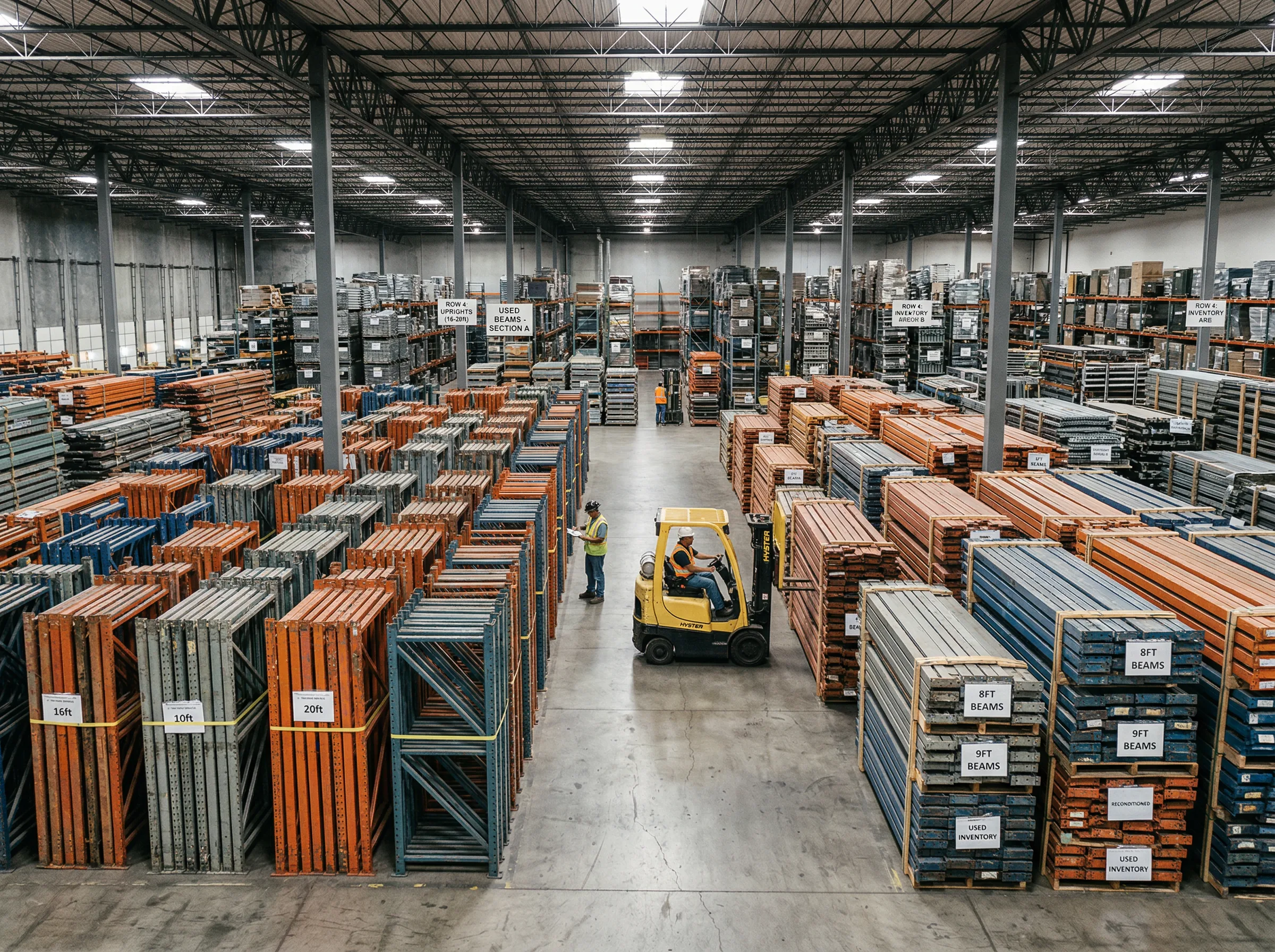
Whether you are buying from a liquidator, a facility closing sale, or a rack dealer, inspect every component before purchase. The categories to evaluate:
- Upright columns: Check every column for dents, bends, buckles, and base plate damage. Even small dents in the column face reduce load capacity significantly. A column with a visible crease or buckle should be rejected — it cannot be safely returned to service.
- Footplates: Base plates should be flat and undamaged. Bent or torn footplates affect anchoring and the column's ability to transfer load to the floor.
- Beams: Check beam webs for cracks, dents, and corrosion. Inspect the connector clips on both ends — damaged or bent clips affect the mechanical connection to the upright. Beams with bent connectors need new connectors, not just visual reinspection.
- Safety clips (beam locks): These small retaining devices prevent beams from being accidentally dislodged. Missing clips are a safety violation. Make sure clips are present and functional before accepting any beam inventory.
- Bracing: Diagonal and horizontal bracing within upright frames must be intact. Damaged frame bracing significantly reduces the column's buckling resistance and load capacity.
- Compatibility: Confirm that all uprights share the same hole pattern, and that all beams from the lot are compatible with those uprights. Mix-and-match combinations are a common and dangerous failure mode in used rack purchases.
The Real Cost Comparison: Used vs. New
Used pallet racking typically sells for 40 to 60 percent of the equivalent new system cost — but the fully-installed cost gap is narrower than the materials price suggests. When comparing used versus new, account for:
- Engineering review and load certification costs for undocumented used rack ($500–$2,000)
- Component replacement costs — beams, clips, or bracing that fail inspection
- Additional labor for sorting, cleaning, and matching incompatible mixed lots
- Permit fees, which apply regardless of whether the rack is new or used
A high-quality, well-documented used system from a single source — ideally with original manufacturer data sheets — can deliver substantial savings with minimal additional cost. A poorly sourced mixed lot with damage and compatibility issues can erode most of that savings advantage before the first pallet goes on the rack.
Where to Source Used Rack in the Baltimore Market
The Baltimore region's used rack market operates through several channels:
- Rack dealers with Maryland inventory: Established used rack dealers maintain inventory from regional liquidations and sell pre-inspected, graded components. This is the lowest-risk option for buyers without deep rack expertise.
- Industrial auctions: Baltimore's active industrial real estate market generates facility liquidation auctions through platforms like Heritage Global Partners and similar firms. Rack lots from these auctions can be excellent value, but require on-site inspection before bidding.
- Direct facility purchases: When a warehouse or CFS operation in the Baltimore metro area closes or downsizes, direct purchase from the outgoing tenant is sometimes possible. This yields the best price and the most complete documentation, since you can obtain original manufacturer data before the lot is dispersed.
Baltimore Pallet Rack operates a used rack buying and selling service serving the Baltimore metro area. We inspect, document, and certify used racking systems and maintain regional inventory. We also purchase used rack from facility liquidations throughout Baltimore City, Baltimore County, and the Maryland I-695 corridor. Call (240) 290-6544 to discuss what we have in stock or to get a quote on racking from a facility you are liquidating.
Getting Used Rack Installed Safely in Baltimore
Purchasing used rack is only half the job. Installation of used racking in Dundalk and throughout the Baltimore metro area follows the same requirements as new rack: engineering drawings, load placards, anchor bolt installation, and local building permits where required. Do not skip this process because the rack is used — the liability and safety risk attach to the installation, not the purchase.
A complete installation by experienced professionals includes sorting and inspecting all components on arrival, rejecting damaged pieces before they go up, installing to manufacturer specs, anchoring all uprights, posting compliant load placards, and providing the documentation your insurer and OSHA inspector will ask for. Our team handles all of this throughout the Baltimore metro area.
Buy or Sell Used Racking in Baltimore
We buy used racking from facility liquidations and sell inspected, certified used rack throughout Baltimore City, Baltimore County, and the Maryland region. Full installation services available.
Contact Us About Used RackReady to Optimize Your Warehouse?
Get a free estimate from Baltimore's warehouse racking experts. We serve warehouses of all sizes throughout the Baltimore, MD metro area.