Repair or Replace Damaged Pallet Racking? A Guide for Baltimore Warehouses
9 min read · May 2026 · Baltimore Pallet Rack Team
When a forklift hits a rack upright in a Baltimore warehouse, the immediate decision — repair or replace — carries real safety and legal consequences. The wrong choice in either direction costs money: unnecessary replacements waste budget, but returning damaged rack to service without proper evaluation creates injury liability that no insurance policy fully covers. Here is the framework for making the right call, based on ANSI/RMI damage classification standards and Maryland-specific documentation requirements.
Critical Safety Note
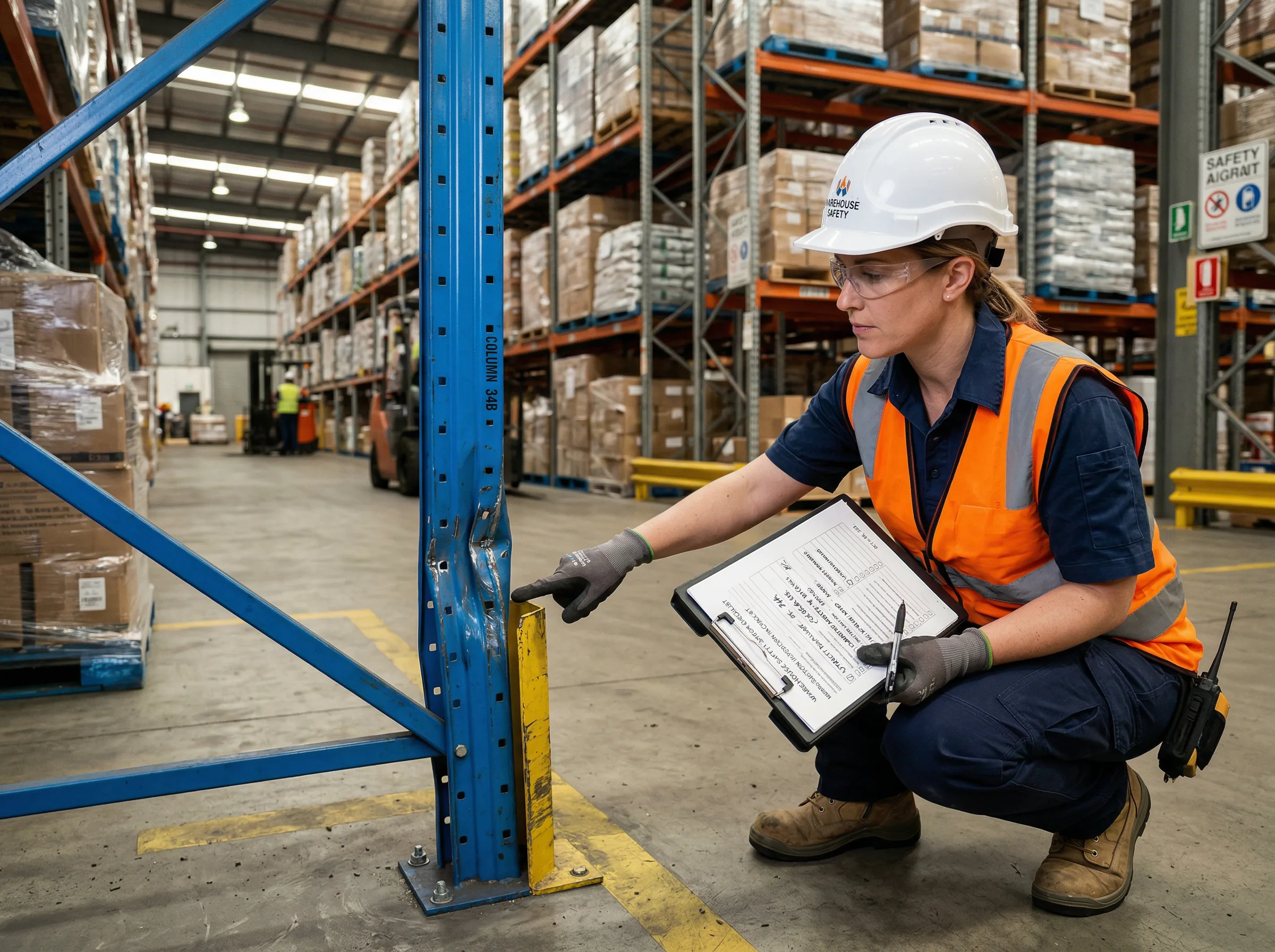
Any rack section involved in a forklift impact or showing visible damage must be offloaded immediately and marked out of service. Do not continue loading damaged rack while awaiting inspection. Baltimore Pallet Rack provides emergency rack inspection and repair throughout the Baltimore metro area.
The ANSI/RMI Damage Classification System
ANSI/RMI MH16.1 — the governing standard for industrial storage rack in the United States — includes a damage classification system that provides a structured framework for evaluating damaged rack components. The system establishes three primary damage categories that determine appropriate response:
Green: Minor Damage — Continue in Service with Monitoring
Green classification damage is minor cosmetic damage that does not affect structural capacity. This includes:
- Superficial paint scratches or coating damage with no deformation of the steel substrate
- Very minor dents with no measurable deviation from the column's original cross-section
- Small surface rust spots without visible pitting of the column profile
Green-classified damage should be documented, monitored for progression, and addressed at the next maintenance cycle — but does not require immediate removal from service. The key word is "monitored": green damage that progresses or is in a high-impact location may be reclassified at the next inspection.
Yellow: Moderate Damage — Take Out of Service, Engineer Review Required
Yellow classification damage involves measurable structural deformation that has reduced the component's load capacity but may be repairable. This includes:
- Dents that cause visible deformation of the column cross-section but do not involve tearing or cracking of the steel
- Column out-of-plumb conditions exceeding ANSI/RMI tolerance (typically more than 0.5 inches per 10 feet of height)
- Beam web dents that cause visible deformation but do not affect the connector interface
- Base plate bending that does not compromise anchor bolt engagement
Yellow-classified damage requires that the affected section be taken out of service immediately and evaluated by a qualified engineer or experienced rack repair technician before returning to service. The evaluation determines whether the component can be repaired to restore adequate capacity, or must be replaced.
Red: Severe Damage — Mandatory Replacement, No Repair
Red classification damage involves structural failure that cannot be safely repaired. ANSI/RMI is explicit: red-classified components must be replaced. This includes:
- Any visible buckling, folding, or kinking of an upright column
- Cracks or tears in column steel, particularly at connection points or lacing welds
- Significant out-of-plumb conditions (column visibly leaning or twisted)
- Beam connectors that are cracked, torn, or significantly deformed
- Any damage in which the column's original cross-section profile is no longer recognizable
A key point that surprises many warehouse managers: field welding or heat-straightening of damaged rack uprights is not an acceptable repair method under ANSI/RMI standards in most circumstances. The heat treatment changes the steel's mechanical properties in unpredictable ways, and a field-welded repair on a load-bearing column creates a structural condition that cannot be reliably engineering-certified. Red-classified components must come out.
When Repair Is Appropriate for Yellow-Classified Damage
For yellow-classified upright damage, column repair kits are the standard approved repair method in the ANSI/RMI framework. These are engineered steel reinforcement sleeves that bolt to the damaged upright column section, restoring column capacity to a certified percentage of the original rating.
A properly installed column repair kit from a reputable manufacturer — Uline, Ridg-U-Rak, and other major rack manufacturers offer them — can restore a yellow-classified column to service with a certified load capacity. The key requirements are:
- The repair kit must be rated for the same column profile and gauge as the original upright
- The damage must not extend into the zone covered by the repair kit's reinforcement sleeve
- Installation must follow the manufacturer's specifications precisely, including torque specs for all bolts
- The repaired load capacity must be re-posted on the load placard if it differs from the original rating
- A qualified engineer should review the repair for any installation that is permitted, subject to insurance requirements, or in a high-traffic damage-prone area
Column repair kits are significantly less expensive than full upright replacement — typically $50 to $200 for the hardware versus $200 to $600 or more for a replacement upright plus installation labor. However, repair is only appropriate when the damage genuinely qualifies as yellow rather than red, which requires an honest assessment by a qualified inspector rather than wishful cost management.
The Cost Comparison Framework
When evaluating repair versus replacement for yellow-classified damage, the true cost comparison must account for all factors, not just materials:
Repair cost components:
- Column repair kit hardware ($50–$200 per kit)
- Labor to offload affected rack section, install repair kit, and reload ($150–$400 depending on rack height and access)
- Engineer review fee if required ($200–$500)
- Updated load placard if capacity changes ($25–$50)
Replacement cost components:
- Replacement upright frame ($200–$800 depending on height and gauge)
- Labor to fully offload and disassemble affected rack section, replace upright, reinstall and reload ($400–$1,200 depending on configuration and height)
- New anchor bolts and installation ($50–$150)
- Updated load placard ($25–$50)
In most scenarios, a properly executed repair on genuine yellow-classified damage costs 30 to 60 percent less than full replacement. However, the repair decision should never be driven purely by cost — if there is any uncertainty about whether the damage qualifies for repair under ANSI/RMI standards, the component must be replaced. The liability exposure from a collapse caused by an improperly repaired component vastly exceeds any savings on a repair kit.
Maryland Liability and Insurance Documentation Requirements
Maryland's warehouse and industrial operations face a legal environment in which rack incident documentation has direct liability implications. Several documentation requirements are worth understanding specifically:
MOSH Incident Reporting
Maryland OSHA (MOSH) requires employers to report work-related fatalities within 8 hours and in-patient hospitalizations, amputations, or eye losses within 24 hours. A rack collapse causing injury triggers these reporting requirements. The documentation you maintain about your rack's condition before the incident — inspection records, damage reports, repair documentation — will be part of any subsequent MOSH investigation. Incomplete or missing records are not neutral: they suggest inadequate safety management.
Workers' Compensation and Property Insurance
Maryland workers' compensation claims arising from rack collapses frequently involve reviews of the employer's maintenance records. Insurers and their subrogation counsel look specifically for evidence of known, unaddressed damage — damage that was observed but not documented, or documented but not repaired. A regular inspection program with written records demonstrating that damage was identified, classified, and either repaired or replaced is the strongest possible defense against subrogation claims and workers' comp premium increases.
Building Permit Documentation
If your rack installation was originally permitted in Baltimore City, Baltimore County, or another Maryland jurisdiction, significant structural modifications — including upright replacement in a permitted installation — may require a permit amendment or notification to the building department. Replacing a damaged upright with an equivalent component typically does not require a new permit, but changing upright profiles, adding height, or reconfiguring the bay layout in a previously permitted installation may trigger permit requirements. Consult your local building department or a qualified engineer if the scope of repairs is extensive.
Building a Damage Response Protocol for Your Warehouse
The best outcome from a rack impact event depends on having a clear protocol in place before the impact happens. Every Baltimore warehouse operation should have:
- A written procedure for what forklift operators and supervisors must do immediately following any rack impact, including tagging the affected section out of service
- A contact number for a qualified rack inspection service — someone who can assess the damage promptly and provide written documentation of their findings and recommendations
- A documented process for deciding repair versus replacement based on inspection findings
- A record-keeping system that maintains inspection reports, repair records, and load placard certifications for the entire racking system
Baltimore Pallet Rack provides rack inspection and repair services throughout Baltimore City, Baltimore County, Howard County, Anne Arundel County, and surrounding Maryland areas. We respond promptly to impact incidents, provide written ANSI/RMI classification assessments, and perform both column repairs and full upright replacements depending on what the damage requires. If the situation warrants new racking rather than repair, we can handle a full pallet racking installation as well. Call us at (240) 290-6544 any time.
Rack Damage Assessment and Repair
We inspect damaged rack against ANSI/RMI standards, provide written damage classification reports, and perform repairs or replacements throughout the Baltimore metro area. Same-week scheduling available.
Request an InspectionReady to Optimize Your Warehouse?
Get a free estimate from Baltimore's warehouse racking experts. We serve warehouses of all sizes throughout the Baltimore, MD metro area.