
Forklift Aisle Width and Pallet Racking in Baltimore Warehouses
8 min read · May 2026 · Baltimore Pallet Rack Team
Aisle width is the single most consequential decision in warehouse layout — and it is one that most operators get wrong by copying a previous tenant's setup rather than engineering it from scratch. In Baltimore and Maryland warehouses where square footage is at a premium, the difference between a 12-foot aisle and a 10-foot aisle multiplied across a full rack installation can represent tens of thousands of dollars of additional storage capacity. Here is how to get it right.
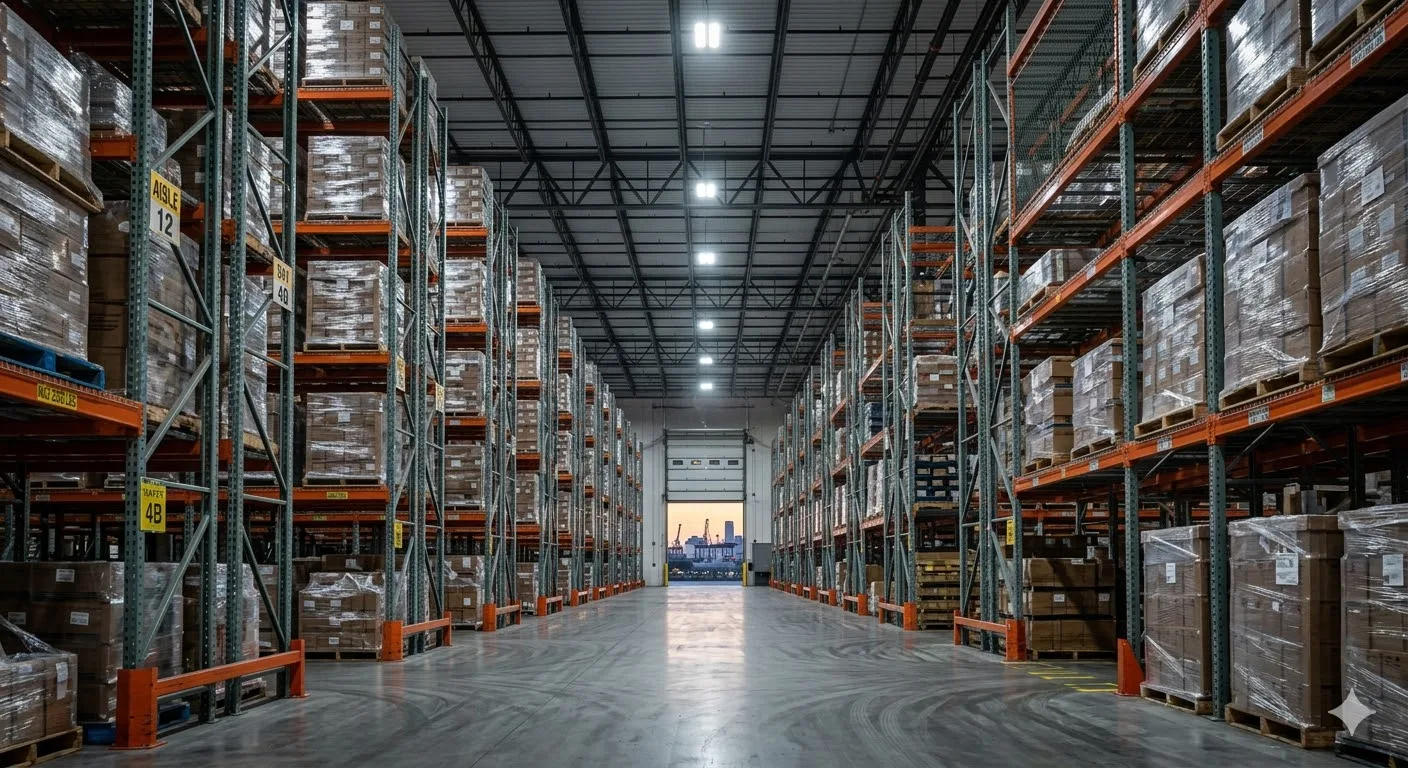
The Three Aisle Width Categories
Warehouse aisles fall into three general categories, each matched to specific forklift types. Getting the pairing right is essential — the wrong forklift in the wrong aisle is both a safety hazard and an efficiency killer.
Wide Aisle (10–14 feet)
Wide aisles are designed for counterbalanced forklifts — the traditional sit-down or stand-up counterbalanced machines that most warehouse operators are familiar with. These are the most common forklifts in Baltimore warehouses and require the most aisle space to turn into rack bays.
The required aisle width for a counterbalanced forklift equals the forklift's right-angle stacking aisle (RASA) dimension from the manufacturer's spec sheet, plus the load overhang on both sides. For a typical 4,000–6,000 lb capacity counterbalanced forklift handling 48-inch deep pallets, this works out to approximately 11 to 13 feet of clear aisle width.
OSHA 29 CFR 1910.178 requires at minimum that aisles used by forklifts be at least 3 feet wider than the widest vehicle or load. Always verify against your specific forklift's RASA spec — not a generic rule of thumb.
Narrow Aisle (8–10 feet)
Narrow aisle warehouses use reach trucks or swing-mast forklifts that extend the forks forward into the rack bay rather than driving in with the load. These machines can operate in aisles as tight as 8 to 9 feet of clear width while reaching loads into double-deep or standard single-deep rack positions.
Narrow aisle layouts are popular in Baltimore industrial districts like Holabird Avenue, O'Donnell Street, and White Marsh where older warehouse footprints make every square foot count. Converting from wide-aisle to narrow-aisle typically requires a smooth, flat concrete floor (reach trucks are sensitive to floor flatness), purchasing or leasing different equipment, and retraining operators.
Very Narrow Aisle (5–7 feet)
Very narrow aisle (VNA) systems use man-up turret trucks or order pickers that travel in fixed-guide aisles — either wire-guided floor rails or optical guides painted on the floor. These machines do not turn in the aisle; they travel forward and extend laterally to pick from both sides of the aisle.
VNA systems deliver the highest storage density of any conventional rack configuration, but require the largest capital investment in both equipment and infrastructure. They are most commonly found in large Baltimore-area distribution centers and port-adjacent logistics facilities where land costs make high-density storage economically compelling.
OSHA Aisle Width Requirements in Maryland
OSHA aisle width requirements for Maryland warehouses come from two primary standards:
- 29 CFR 1910.22(b): Aisles and passageways used by mechanical equipment must be kept clear. Permanent aisles must be appropriately marked.
- 29 CFR 1910.178(n)(4): Adequate clearance must be maintained for aisles and at loading docks or passages. Where a specific minimum is not set, aisles must be at least 3 feet wider than the largest equipment used.
Maryland OSHA (MOSH) enforces these standards and has authority to inspect warehouses throughout Baltimore City, Baltimore County, and surrounding counties. Aisle marking — typically with painted yellow lines on the floor — is not optional when mechanical equipment operates in those aisles. It is an OSHA requirement.
Local fire codes also impose minimum aisle requirements. Baltimore City Fire Department and Baltimore County Fire requirements include minimum 44-inch aisles for occupant egress, which must be maintained independently of operational aisle requirements. In practice, this means your smallest aisle in any occupied section of the warehouse cannot be less than 44 inches even if OSHA would permit it for pedestrian-only areas.
How Aisle Width Directly Affects Storage Density
The relationship between aisle width and storage capacity is straightforward but the math surprises many operators. In a typical 30,000 square foot Baltimore warehouse, consider two configurations storing 48-inch deep pallets in standard selective rack:
- 12-foot wide aisles: Each rack-plus-aisle module takes approximately 20 feet of building width (4 ft rack + 12 ft aisle + 4 ft rack). A 120-foot building width accommodates 6 modules, or 12 rack rows.
- 9-foot narrow aisles with reach trucks: Each module takes approximately 17 feet (4 ft rack + 9 ft aisle + 4 ft rack). The same 120-foot building accommodates 7 modules, or 14 rack rows — a 17 percent increase in storage positions with no change to the building footprint.
Over a full warehouse floor, this difference compounds significantly. When multiplied by 4 or 5 rack levels, narrow aisle conversion can add hundreds of pallet positions to an existing facility — without moving to a larger building.
Aisle Width and Rack Column Protection
Tighter aisles mean more forklift-to-rack proximity, which means more impact events. This is not a reason to avoid narrow aisle layouts, but it is a reason to invest in column protection from day one. Every pallet rack installation with forklift access should have:
- End-of-aisle guards (floor-mounted bollards or rack-mounted wire protectors) at every row entry point
- Column guards on the first 16 to 24 inches of every exposed upright in forklift travel paths
- Painted floor markings showing the rack face location so operators can identify the aisle boundary without relying on line-of-sight alone
In narrow and very narrow aisle configurations, wire guides and optical aisle guides serve a dual function: keeping the forklift centered in the aisle while also preventing the rack-face impacts that gradually destroy uprights over time.
Baltimore Warehouse Characteristics That Affect Aisle Planning
Baltimore-area industrial real estate has characteristics that directly affect aisle width planning. Older warehouse buildings in the Dundalk, Holabird, and Middle River corridors often have concrete columns on 20 to 25-foot centers, irregular building widths, and existing dock door placements that constrain where aisles can run. Modern distribution centers in White Marsh, Jessup, and the BWI corridor tend to have clearer spans and more flexibility.
Column spacing is particularly important: a concrete column falling in the middle of a planned aisle requires either relocating the aisle grid or accepting a reduced-width section at that point, which may constrain which forklift types can operate there. A proper warehouse layout analysis accounts for every column, door, sprinkler riser, and mechanical obstruction before finalizing aisle placement.
Our team at Baltimore Pallet Rack performs warehouse design and space planning services that include aisle layout optimization for your specific forklift equipment and storage requirements throughout the Baltimore metro area.
Making the Right Aisle Decision for Your Operation
There is no universal right answer on aisle width — the best configuration depends on your throughput requirements, your existing or planned forklift fleet, your floor condition, your product mix, and your lease term. What we consistently see is that operators who choose aisle widths based on convention rather than analysis either leave significant storage capacity on the table or create operational bottlenecks that cost more in labor efficiency than they saved on equipment.
If you are setting up a new facility, reconfiguring existing rack, or evaluating a lease space in White Marsh, Jessup, or anywhere in the Baltimore metro area, a professional layout review before committing to a rack installation is time and money well spent. Call us at (240) 290-6544 to discuss your project.
Plan Your Warehouse Layout Right
We design optimized rack layouts — including aisle width analysis — for warehouses throughout Baltimore City, Baltimore County, Howard County, Anne Arundel County, and surrounding Maryland areas.
Request a Layout ConsultationReady to Optimize Your Warehouse?
Get a free estimate from Baltimore's warehouse racking experts. We serve warehouses of all sizes throughout the Baltimore, MD metro area.