
Pallet Racking for Baltimore Port Warehouses and Distribution Centers
10 min read · May 2026 · Baltimore Pallet Rack Team
The Port of Baltimore is the busiest auto-import port on the East Coast and one of the top ten container ports in the United States. Warehouses serving Seagirt Marine Terminal, Dundalk Marine Terminal, and the broader Tradepoint Atlantic logistics campus operate under conditions that make standard pallet racking specifications inadequate. Salt-air corrosion, container-freight surge cycles, high-throughput import deconsolidation, and the proximity of I-695 and I-95 all shape how racking systems need to be designed, specified, and maintained in this corridor.
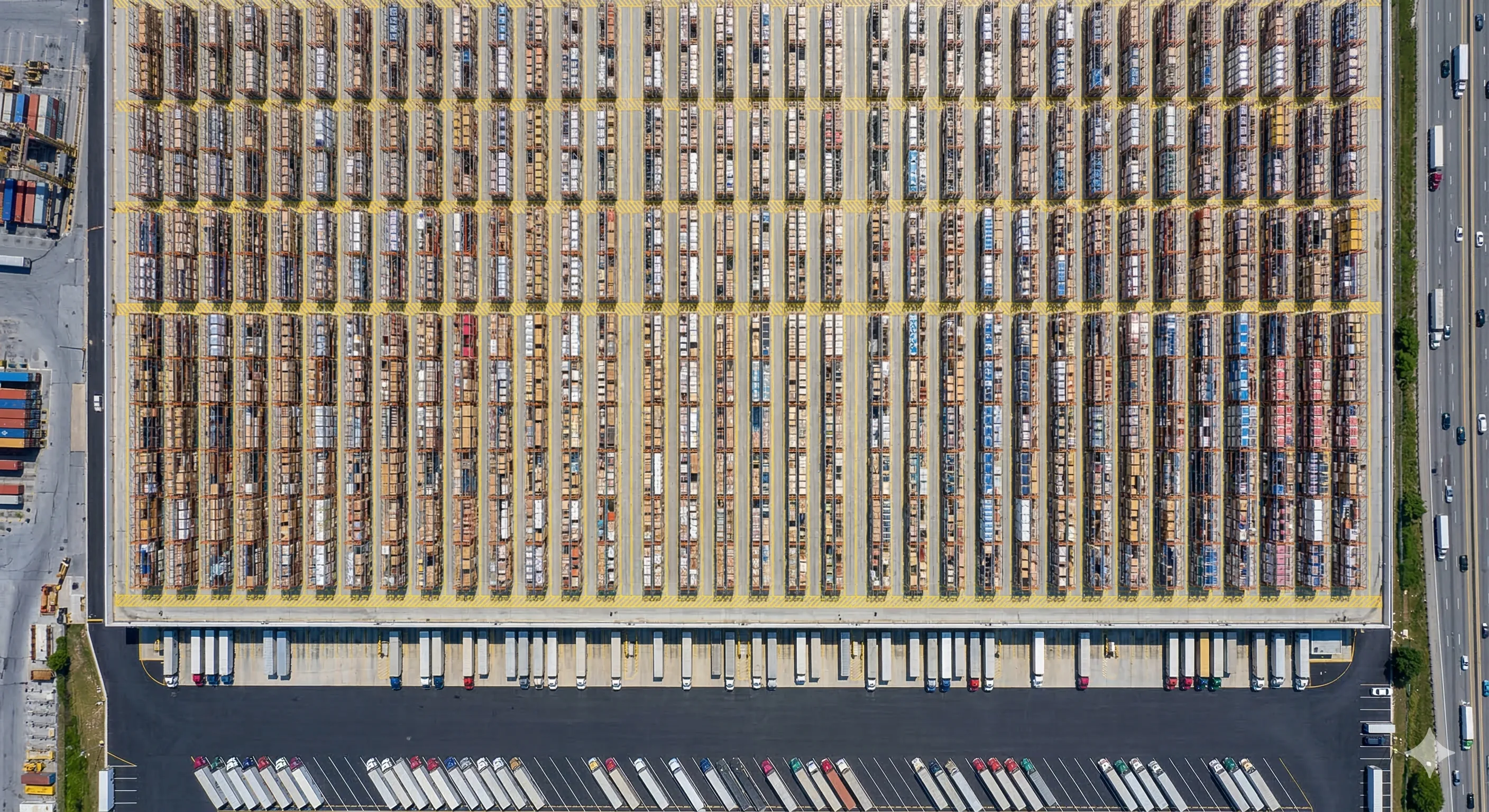
The Port of Baltimore Logistics Landscape
Understanding why port-adjacent racking differs from standard warehouse installations requires understanding the port's operating structure:
Seagirt Marine Terminal
Seagirt Marine Terminal, operated by Ports America Chesapeake under a 50-year concession agreement with the Maryland Port Administration, is Baltimore's primary container terminal. Seagirt handles the majority of Baltimore's container throughput and features the 50-foot deep berth that allows post-Panamax vessels to call directly — something only a handful of East Coast ports can accommodate. Warehouses serving Seagirt's container freight stations (CFS) and off-dock consolidation operations are primarily located in the Holabird Avenue industrial corridor (ZIP 21224) and the South Baltimore waterfront zone.
Dundalk Marine Terminal
Dundalk Marine Terminal, the older of Baltimore's two major terminals, handles roll-on/roll-off (RORO) cargo — primarily automobile imports from European and Asian manufacturers — as well as breakbulk freight. The warehouses surrounding Dundalk Marine Terminal, including facilities at Tradepoint Atlantic (the redeveloped Bethlehem Steel Sparrows Point campus), serve import deconsolidation, auto-processing, and general logistics functions. These facilities sit at tidewater — directly adjacent to the Patapsco River and the Chesapeake Bay — and face the most aggressive salt-air exposure of any warehouse submarket in the Baltimore metro.
The I-695 / I-95 Connectivity Advantage
Both terminals are within five miles of the intersection of I-695 (the Baltimore Beltway) and I-95, giving port-adjacent warehouses direct access to the entire East Coast freight network. This connectivity drives high-velocity throughput requirements — port-adjacent warehouses frequently process import containers within 24 to 72 hours of vessel unloading, which means racking systems need to accommodate rapid inventory turnover rather than long-term dense storage.
The Salt-Air Problem: Why Standard Rack Finishes Fail
This is the single most commonly underestimated factor in Baltimore port warehouse racking. Facilities within approximately two miles of tidewater — which includes all warehouses directly serving Seagirt, Dundalk, and Tradepoint Atlantic — experience chloride salt concentrations in the ambient air that accelerate corrosion on standard painted steel rack components at a rate that surprises most operators new to the market.
The failure pattern is predictable: standard painted uprights in port-adjacent facilities typically begin showing rust bleed at the base plates within 18 to 24 months of installation. Within three to five years, base plate corrosion can reach structural significance — compromising anchor integrity and requiring upright replacement at significant cost. In the most exposed locations at Tradepoint Atlantic and along the Sparrows Point industrial waterfront, the timeline is even more aggressive.
Galvanized vs. Epoxy-Coated Uprights
The two specification-grade responses to salt-air exposure are hot-dip galvanized uprights and epoxy-coated uprights. Both significantly outperform standard painted steel in tidewater-adjacent environments:
- Hot-dip galvanized: The most durable option, involving immersion of the steel component in molten zinc. Galvanized uprights resist corrosion for 25+ years in even aggressive marine environments. The trade-off is cost — galvanized components typically run 20 to 35 percent more than standard painted equivalents — and lead time, as galvanized components are not typically stocked and must be ordered.
- Epoxy-coated uprights: A factory-applied epoxy powder coat over cleaned and primed steel provides significantly better corrosion resistance than standard polyester powder coat. Epoxy-coated systems cost less than galvanized and are available with standard lead times from most major manufacturers. In moderately exposed locations — two to three miles from tidewater — epoxy coating is generally sufficient. In directly waterfront locations like Tradepoint Atlantic's shoreline facilities, galvanized is the stronger specification.
- Galvanized hardware: Regardless of upright finish, all anchor bolts, beam safety clips, row spacers, and cross-bracing hardware should be specified as hot-dip or mechanical galvanized in port-adjacent installations. Standard zinc-plated hardware corrodes rapidly in salt-air environments.
Baltimore Pallet Rack's standard specification for any installation within two miles of Seagirt, Dundalk, or Tradepoint Atlantic includes galvanized or epoxy-coated uprights and galvanized hardware throughout. Retrofitting after corrosion develops costs roughly three times what upgrading at installation would have. See our Dundalk pallet racking page for more on port-adjacent specifications.
High-Turnover Import Inventory: Racking Patterns That Work
Container freight station (CFS) operations and import deconsolidation warehouses have fundamentally different inventory patterns than manufacturing or retail distribution facilities. Import cargo arriving at Seagirt and Dundalk typically moves from vessel to warehouse to outbound truck within 48 to 96 hours — meaning pallet positions turn over several times per week rather than several times per year.
This high-velocity pattern drives specific racking configuration choices:
Heavy-Duty Selective Racking with Wide Aisles
Selective pallet racking with full aisle access to every pallet position remains the dominant configuration in Baltimore port warehouses. The reasons are operational: import cargo is mixed-SKU, high-weight, and frequently handled by counterbalance forklifts operating at high cycle rates. Wide aisles (12 to 14 feet for counterbalance forklift operations) allow the throughput speed the port environment demands. The cost of less-than-perfect cube utilization is offset by the gain in throughput velocity.
Beam sizing in port CFS operations typically specifies heavier beams than in typical warehouse applications — 3,000 to 5,000 pound-per-pair capacity is common to accommodate the mixed-weight, hard-to-characterize nature of import container cargo.
Staging Lane Configurations
Port-adjacent warehouses frequently dedicate significant floor space to staging lanes — open floor areas between rack sections where containers can be deconsolidated and sorted before pallets are put away into rack. Racking layout in CFS operations needs to leave adequate staging space near dock doors, which often means lower rack density near the dock wall and higher density in the interior of the building.
Drive-In and Push-Back Configurations for Same-SKU Import Cargo
When import cargo arrives in consistent SKU blocks — a common pattern for automotive parts, consumer electronics, and retail goods arriving in dedicated ocean freight containers — drive-in or push-back racking can dramatically improve storage density. A port-adjacent facility handling 500 pallets of a single SKU arriving weekly can recover 25 to 40 percent more cubic storage by shifting those positions from selective to drive-in or push-back racking. This is particularly valuable in the tight, older industrial buildings along the Holabird Avenue corridor where ceiling heights of 22 to 26 feet limit vertical utilization in standard selective configurations.
Container Freight Station (CFS) Requirements
CFS operations serving Seagirt and Dundalk Marine Terminals have specific requirements that affect racking design beyond standard warehouse considerations:
- U.S. Customs and Border Protection (CBP) compliance: CFS facilities operating as Customs-bonded warehouses must maintain physical separation between bonded and non-bonded inventory. Racking layout needs to accommodate designated bonded storage zones with appropriate access controls.
- FDA-regulated imports: Food, pharmaceutical, and cosmetic imports arriving at Baltimore through CFS operations are subject to FDA oversight. Storage areas handling these commodities require sanitation-compatible rack specifications — wire mesh decking, coated uprights, and layouts that facilitate cleaning.
- Hazmat segregation: Container imports frequently include miscellaneous hazardous materials. Racking layouts in CFS warehouses should include designated hazmat storage bays with appropriate separation distances per NFPA and DOT regulations.
- High-cube handling: Import containers increasingly carry overheight pallets and irregularly stacked cargo. Racking beam heights need to accommodate nonstandard pallet profiles, and forklift specifications (mast height, attachment specifications) need to be verified against the actual cargo profile before finalizing racking configuration.
Tradepoint Atlantic: The Largest Racking Opportunity in the Baltimore Market
Tradepoint Atlantic, the 3,300-acre redevelopment of the former Bethlehem Steel Sparrows Point campus at the tip of the Patapsco River, represents the largest industrial development project in Maryland history. Tenants including Amazon, FedEx, Under Armour, and major third-party logistics providers have built or are building facilities totaling tens of millions of square feet on the Tradepoint campus.
Racking requirements at Tradepoint Atlantic reflect the site's unique characteristics:
- New construction with high clear heights: Most Tradepoint buildings are new construction with 36 to 40-foot clear heights, enabling high-bay racking configurations that older Baltimore industrial buildings cannot accommodate
- ESFR sprinkler systems: Modern Tradepoint buildings are equipped with ESFR (Early Suppression Fast Response) sprinkler systems, which require specific rack row spacing and flue space configurations to maintain fire suppression coverage
- Direct tidewater salt-air exposure: Tradepoint sits at the tip of the Patapsco River, making it among the most salt-air-exposed industrial real estate in the Baltimore metro — galvanized specifications are strongly recommended for all racking installations on the campus
- Scale: Tradepoint tenant racking projects frequently involve tens of thousands of pallet positions, requiring project management capabilities beyond typical warehouse installations
Baltimore Pallet Rack serves Tradepoint Atlantic tenants with full-scale racking installation services, including galvanized specifications, ESFR coordination, and engineering and permitting through Baltimore City DHCD for facilities within the Baltimore City limits portion of the campus.
What to Ask Before Specifying Racking in a Port-Adjacent Baltimore Warehouse
Whether you are taking a new lease at Tradepoint Atlantic, expanding a CFS operation in the Holabird corridor, or installing rack in a Dundalk-area logistics facility, these are the questions to resolve before finalizing your racking specification:
- How close is the facility to tidewater? (Galvanized or epoxy-coated uprights if within two miles)
- What is the sprinkler system type? (ESFR requires row spacing and flue space coordination)
- What is the forklift type and aisle requirement? (Counterbalance, reach, or articulated — each drives different aisle width specifications)
- Is the facility a CFS or bonded warehouse? (Customs, FDA, and hazmat zoning requirements affect layout)
- What is the expected inventory turnover? (High-velocity port operations favor selective; same-SKU bulk import may favor drive-in or push-back)
- Is the facility in Baltimore City or Baltimore County? (Permits go to DHCD vs. Baltimore County PAI — different processes and timelines)
- What are the slab conditions? (Pre-1980 slabs in Holabird and South Baltimore require pachometer scanning before anchor layout)
Port-Ready Racking for Baltimore Warehouses
We spec galvanized finishes, coordinate ESFR requirements, and manage Baltimore City and County permits for racking projects at Seagirt, Dundalk, and Tradepoint Atlantic facilities. Call (240) 290-6544 for a site-specific quote.
Get a QuoteRelated Services & Areas
Ready to Optimize Your Warehouse?
Get a free estimate from Baltimore's warehouse racking experts. We serve warehouses of all sizes throughout the Baltimore, MD metro area.