
Pallet Racking for Baltimore E-Commerce Fulfillment Centers
10 min read · May 2026 · Baltimore Pallet Rack Team
Baltimore's geographic position in the mid-Atlantic gives it a structural advantage that few markets can match for e-commerce fulfillment. A single distribution center in the Baltimore metro can reach Washington DC in 40 minutes, Philadelphia in 90 minutes, and New York City in 3 hours — putting roughly 20 million people within same-day delivery range and nearly 50 million within next-day range. That radius drives demand for Baltimore-area fulfillment space, and the racking systems inside those facilities need to be designed specifically for fulfillment velocity, SKU density, and the pick-path optimization that separates profitable e-commerce operations from ones that drown in labor costs.
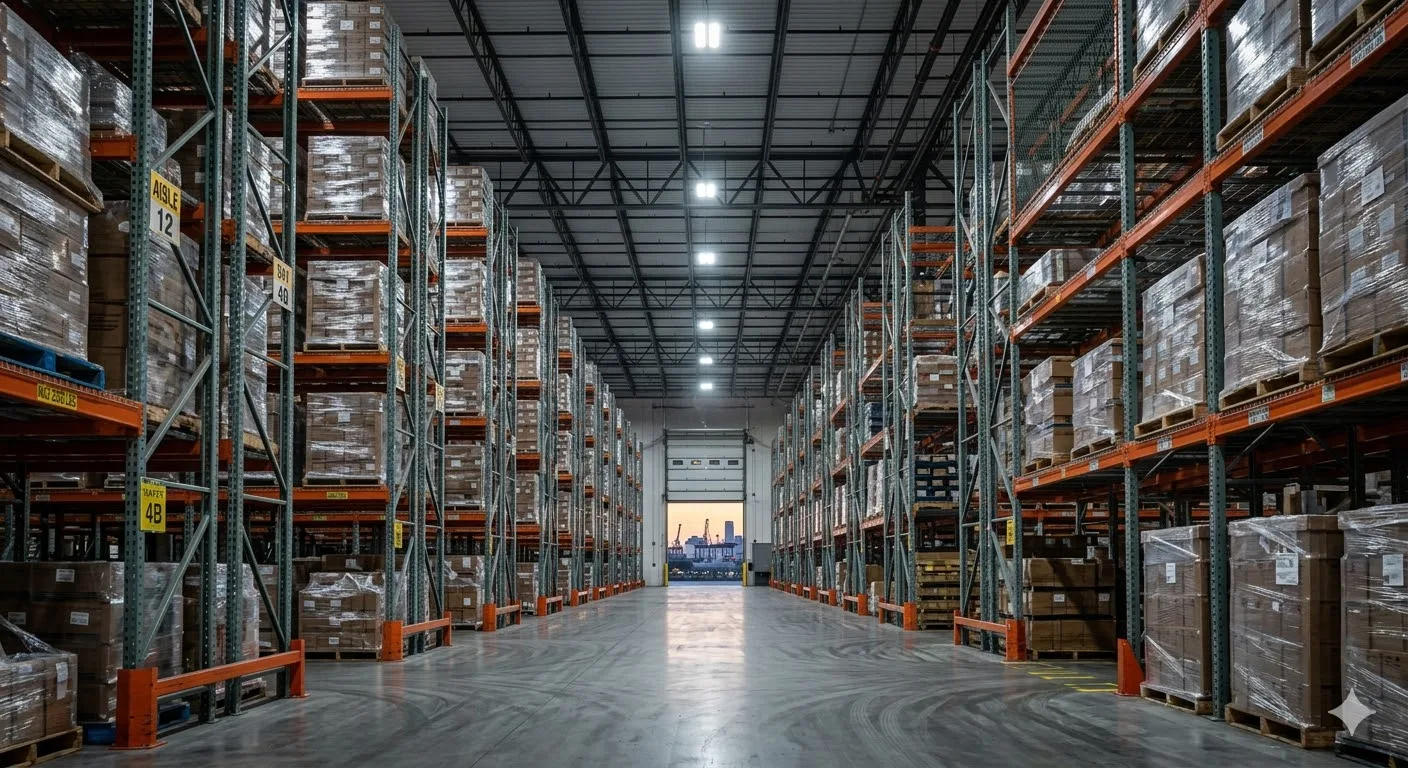
Baltimore's Mid-Atlantic Fulfillment Advantage
E-commerce logistics networks are built around delivery radius mathematics. The cost of same-day and next-day delivery drops dramatically with every mile closer the fulfillment center sits to the end customer. Baltimore's position between the DC metro (4.5 million people), the Philadelphia metro (6 million people), the Baltimore metro itself (2.9 million people), and the Northern Virginia tech corridor makes it one of the highest-value single-node positions for mid-Atlantic e-commerce fulfillment.
The numbers matter operationally: a fulfillment center in the Baltimore metro can serve same-day orders to customers in Baltimore, the DC suburbs, and parts of Northern Virginia, while running next-day truck routes to Philadelphia and New York overnight. No single facility in any of those individual markets can match that reach without multiple node investments. That efficiency advantage — and the lower real estate costs compared to DC, Philadelphia, and New York — explains why major e-commerce operators, including Amazon, Chewy, Fanatics, and numerous third-party logistics providers, have built large fulfillment operations in the Baltimore metro.
Baltimore's Key E-Commerce Fulfillment Submarkets
White Marsh: Northeast Baltimore's Fulfillment Hub
White Marsh, along I-95 at the MD-43 interchange in northeastern Baltimore County, is the single largest concentration of e-commerce fulfillment space in the Baltimore market. The White Marsh distribution campus includes several multi-million square foot facilities operated by major e-commerce and retail distribution tenants. Key characteristics for racking operators:
- Modern high-bay buildings: White Marsh facilities are predominantly new or recently developed construction with 36 to 40-foot clear heights, enabling high-bay racking configurations including VNA systems with guided trucks
- ESFR sprinkler systems: All modern White Marsh facilities have ESFR systems, which require specific rack row spacing, flue space maintenance, and configuration coordination
- I-95 and I-695 access: The White Marsh interchange gives direct access to I-95 north and south and I-695 east and west — optimal for both inbound freight and outbound last-mile delivery
- Baltimore County permitting: White Marsh falls in unincorporated Baltimore County, with permits through Baltimore County's Department of Permits, Approvals and Inspections
Sparrows Point / Tradepoint Atlantic: Port-Adjacent Fulfillment
Tradepoint Atlantic, the redeveloped Bethlehem Steel campus on the Sparrows Point peninsula, is emerging as a major e-commerce and logistics hub that combines port-adjacent container access with large-scale modern warehouse construction. Facilities at Tradepoint can receive import containers directly from the adjacent Dundalk Marine Terminal and process them for e-commerce fulfillment without the drayage cost of moving containers inland.
This port-to-fulfillment integration model is increasingly attractive for e-commerce operations that import high volumes of consumer goods from Asia — apparel, electronics, consumer products — and need to move quickly from container arrival to pick-and-ship. Tradepoint's RORO import capabilities (Dundalk handles the majority of East Coast auto imports) also create opportunities for automotive parts fulfillment operations.
Racking at Tradepoint Atlantic follows the salt-air specification requirements described in our port warehouse racking guide — galvanized or epoxy-coated uprights are standard for any installation on the campus.
Linthicum and BWI: Air Freight E-Commerce
E-commerce operations with time-sensitive inventory — fashion, consumer electronics, health and beauty — increasingly use air freight for a portion of their inbound supply chain. Fulfillment facilities adjacent to BWI in Linthicum and Hanover can receive air freight from BWI's cargo complex and move it directly into the fulfillment workflow, reducing the lag between merchandise receipt and customer order availability. These facilities typically operate the same high-SKU selective rack and pick module configurations as ground-freight fulfillment centers, with the addition of cold-chain capable zones for temperature-sensitive products.
E-Commerce Racking: What Makes Fulfillment Different from Traditional Distribution
Traditional distribution racking is optimized for pallet-in, pallet-out operations — full pallet put-away and full pallet pick for retail replenishment. E-commerce fulfillment is fundamentally different: the unit of pick is almost always a single item or a small number of items, order counts are measured in thousands per day rather than hundreds, and SKU counts are typically orders of magnitude higher than traditional retail distribution. These differences drive completely different racking system choices.
High-SKU Selective Rack: The Fulfillment Foundation
Selective pallet racking remains the foundational storage system in most e-commerce fulfillment centers, but configured very differently from conventional warehouse applications:
- Shallow beam spacing: Fulfillment operations picking from cartons or small items on the rack face often use shallower bay heights — 18 to 24 inches between beams — to maximize the number of pick faces per upright height rather than maximizing pallet position count
- Wire mesh decking throughout: Wire mesh decking on every level enables carton-level storage and picking across the full rack height, not just at floor and first-beam levels
- Velocity-based slotting: Fast-moving SKUs are positioned in the "golden zone" — roughly waist to shoulder height — to minimize picker reach and bend cycles. This is distinct from density-optimized slotting and requires different beam height configurations
- Dynamic slotting flexibility: E-commerce SKU velocity distributions shift rapidly with promotions, seasonality, and product launches. Selective rack with standard beam clip connections allows relatively easy reconfiguration as slotting needs change
Carton Flow Rack: FIFO for High-Velocity SKUs
Carton flow racking — gravity-fed inclined lanes that move cartons from the back of the lane to the front as picks are made — is one of the most powerful tools for high-velocity e-commerce fulfillment. Key advantages in Baltimore fulfillment operations:
- Separated replenishment and picking: Replenishment workers load from the back of the lane while pickers work from the front — eliminating the aisle congestion that slows down operations when picking and replenishment compete for the same aisle access
- Higher pick density: Carton flow lanes can be configured at narrower depths than standard pallet rack bays, allowing more pick faces per linear foot of racking
- FIFO rotation: Gravity feed ensures FIFO inventory rotation — important for products with expiration dates (health and beauty, food, pharmaceuticals) and for operations where "sell-through" inventory accuracy is critical
- Scalable to velocity: Carton flow inserts can be installed within standard selective rack frames, allowing fulfillment operations to upgrade high-velocity positions without replacing the underlying rack structure
Pick-Path Optimization for Baltimore Fulfillment Centers
In a high-velocity fulfillment center picking thousands of orders per day, the distance a picker walks per order is the single largest controllable driver of labor productivity. Pick-path optimization — designing the racking layout and slotting strategy to minimize picker travel — can reduce labor costs by 20 to 35 percent compared to an unoptimized layout with the same racking system and SKU count.
Zone-Based Picking
Most large-scale Baltimore fulfillment operations use zone-based picking, where each picker is responsible for a specific physical zone of the warehouse. Orders are split by zone, picked separately, and consolidated at a pack station or conveyor sorter. Zone-based picking reduces picker travel per line and allows specialization — pickers become faster in their zones with repetition. Racking layout needs to support clean zone boundaries with logical product groupings and clear pick-path flow within each zone.
Batch Picking and Conveyor Integration
Higher-volume Baltimore fulfillment operations frequently use batch picking — a single picker fills multiple orders simultaneously, using a multi-tote cart or conveyor induction — combined with downstream sortation to consolidate orders. This approach requires racking aisle widths and pick face configurations that accommodate multi-tote carts without bottlenecking in high-traffic zones. Conveyor integration — induction points at the ends of pick aisles that feed orders into a sortation system — requires specific rack-end configurations and clearance zones that need to be designed into the layout from the beginning.
Slotting Strategy for Baltimore E-Commerce
Effective slotting strategy for Baltimore fulfillment centers considers the specific demand patterns of mid-Atlantic e-commerce:
- Seasonality: Mid-Atlantic e-commerce demand has pronounced seasonality — holiday peak (November-December), back-to-school (July-August), and regional events drive significant velocity swings. Slotting needs to account for these shifts, with fast-mover zones that can be re-slotted seasonally without major rack reconfiguration
- SKU proliferation: E-commerce SKU counts grow rapidly as product assortments expand. Racking capacity planning needs to accommodate 20 to 40 percent SKU count growth over a 3 to 5-year horizon without requiring fundamental layout changes
- Returns processing: E-commerce returns rates — typically 15 to 30 percent for apparel, 5 to 10 percent for hard goods — require dedicated reverse logistics space adjacent to or integrated with primary storage. Returns processing areas need racking that accommodates unsorted, variable-condition product in a lower-density configuration
Pick Module Design: Multi-Level Fulfillment for High-SKU Operations
Large-scale Baltimore e-commerce fulfillment operations with high SKU counts and throughput requirements frequently use pick modules — multi-level steel structures that combine racking, conveyors, and picking platforms into a single integrated system. Pick modules enable fulfillment centers to maximize both cubic utilization and picking throughput simultaneously:
- Multiple picking levels within the building height (typically 2 to 4 levels in 36 to 40-foot clear buildings)
- Carton flow and gravity conveyor on each level feeding pickers standing at the pick face
- Take-away conveyor on each level delivering picked cartons to a main sortation conveyor
- Pallet rack on the upper levels for bulk reserve storage above the active pick faces
Pick modules are capital-intensive but deliver the highest throughput per square foot of any fulfillment racking configuration. For White Marsh and Tradepoint Atlantic facilities processing 10,000 or more orders per day, pick modules are often the right choice. Baltimore Pallet Rack's warehouse design and space planning service includes pick module feasibility analysis and layout for Baltimore-area fulfillment operations.
ESFR Coordination for Baltimore Fulfillment Centers
Virtually all modern Baltimore-area fulfillment facilities — White Marsh, Tradepoint Atlantic, Linthicum, and the Jessup corridor — are equipped with ESFR (Early Suppression Fast Response) sprinkler systems. ESFR systems are preferred for high-bay fulfillment because they can suppress fires without in-rack sprinklers in many configurations, reducing installation cost and operational complexity.
However, ESFR systems impose strict requirements on racking configuration:
- Longitudinal flue spaces: ESFR systems require 6-inch minimum flue spaces between pallet loads in the longitudinal direction (along the rack face). Operators who eliminate flue spaces to squeeze in more pallet positions compromise ESFR coverage and risk fire code violations
- Transverse flue spaces: 6-inch minimum transverse flue spaces between back-to-back rack rows are required for ESFR systems — the flue must remain clear of product throughout the row
- Maximum storage height: ESFR systems are approved for specific storage height limits based on commodity class. Storing above the approved height — or changing commodity class without re-evaluating the ESFR system — can invalidate the suppression coverage
- Rack reconfiguration notification: Any significant change to rack configuration in an ESFR-protected facility should be reviewed by the fire protection engineer and, in some cases, reported to the local fire marshal to confirm continued ESFR coverage adequacy
Baltimore Pallet Rack coordinates ESFR compliance as a standard part of every fulfillment center racking project, confirming flue space specifications in our layout drawings and communicating compliance requirements to the operations team.
Planning Your Baltimore Fulfillment Racking Investment
Whether you are standing up a new fulfillment operation in White Marsh, reconfiguring an existing operation in Linthicum, or evaluating a Tradepoint Atlantic location, these principles apply across the Baltimore market:
- Design for the 3-year SKU count, not today's: E-commerce SKU counts grow faster than most operators plan for — build in 30 to 40 percent SKU capacity headroom from the start
- Velocity-zone your layout before you design the rack: Identify your top 20 percent of SKUs (which typically account for 80 percent of picks) and design the racking layout around getting those SKUs into the golden zone near dispatch doors
- Specify ESFR-compatible flue spaces from day one: Modifying flue space configurations after occupancy is disruptive and expensive — get it right in the design phase
- Confirm permits before committing to a configuration: Both Baltimore County (White Marsh) and Anne Arundel County (Linthicum) have clear permitting processes, but changes to rack configuration after permit issuance can require re-review
- Plan for returns from the start: Returns processing space and racking is frequently an afterthought — build it into the initial layout design rather than squeezing it in later
Fulfillment Racking for Baltimore's E-Commerce Market
Baltimore Pallet Rack designs, supplies, and installs fulfillment-optimized racking for operations throughout White Marsh, Tradepoint Atlantic, Linthicum, Jessup, and the entire Baltimore metro. From pick module feasibility to ESFR-coordinated selective rack, we handle it all. Call (240) 290-6544 or contact us online.
Plan Your Fulfillment RackingRelated Services & Areas
Ready to Optimize Your Warehouse?
Get a free estimate from Baltimore's warehouse racking experts. We serve warehouses of all sizes throughout the Baltimore, MD metro area.