Pallet Racking Permits in Baltimore: City vs. County Guide
10 min read · May 2026 · Baltimore Pallet Rack Team
Maryland's patchwork of local jurisdictions means there is no single answer to "do I need a permit to install pallet racking?" The answer depends on exactly where your warehouse sits — and whether you are dealing with Baltimore City, Baltimore County, Harford County, Howard County, or another jurisdiction entirely. This guide breaks down each permitting authority, what triggers a permit, what documentation you need, and how the timelines compare.
Important Note
Permit requirements change. Always confirm current thresholds with the applicable building authority before starting a project. Baltimore Pallet Rack manages the complete permitting process for racking projects throughout all Maryland jurisdictions — call (240) 290-6544 for guidance specific to your facility.
Why Permitting Is More Complex in the Baltimore Metro Than You Might Expect
Unlike a single-county metro area, Baltimore's industrial market straddles Baltimore City (an independent city with no county government), Baltimore County (which surrounds but does not include the city), and a ring of neighboring counties — Howard, Harford, Anne Arundel, and Carroll — each with independent building departments, plan review processes, and permit thresholds. A warehouse on one side of the Baltimore Beltway (I-695) may fall under an entirely different jurisdiction than a facility a quarter mile away.
On top of jurisdictional differences, two state-level overlays apply everywhere in the Baltimore metro:
- Maryland Building Performance Standards (MBPS): Adopts the International Building Code (IBC) statewide, requiring a Professional Engineer (PE) stamp on structural submissions for commercial rack installations in most circumstances.
- Maryland OSHA (MOSH): Enforces occupational safety standards for all Maryland employers, including requirements for load capacity documentation and rack inspection records.
Baltimore City DHCD: The Most Demanding Process in the Region
Baltimore City's Department of Housing and Community Development (DHCD) is the authority having jurisdiction (AHJ) for commercial building permits inside the city limits. The city operates as its own independent jurisdiction — it is not part of Baltimore County — and has built up its own permitting culture over more than a century of industrial development.
What Triggers a Baltimore City Permit
In Baltimore City, a commercial building permit is generally required for any pallet racking installation that:
- Exceeds 5 feet 9 inches in height (the IBC threshold commonly applied by DHCD)
- Involves structural attachment to the building floor, walls, or roof
- Triggers a fire sprinkler review under IFC Chapter 32 (high-piled storage above 12 feet of commodity)
- Is located in a leased commercial occupancy that did not previously have racking
What Baltimore City DHCD Requires
A complete Baltimore City racking permit submission typically includes:
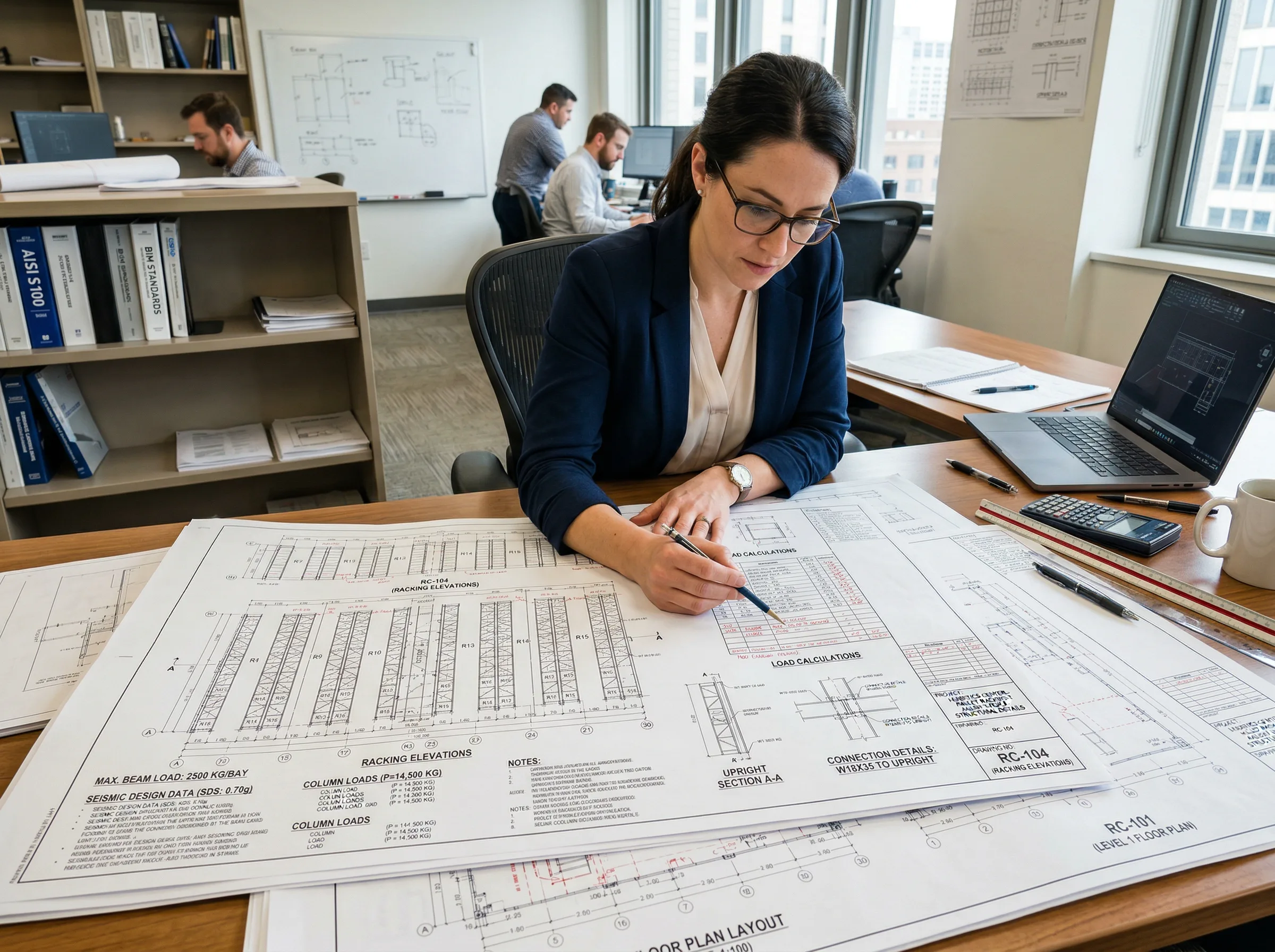
- Maryland-PE-stamped structural drawings: Rack layout, upright sizing, beam specifications, anchorage details, and seismic calculations per ASCE 7 Seismic Design Category B (which applies throughout Baltimore City)
- Load capacity analysis: Documented maximum pallet loads per bay
- Sprinkler coordination: If high-piled storage thresholds are triggered, a separate fire protection engineering submittal is required and reviewed in parallel by the Baltimore City Fire Department (BCFD)
- Certificate of occupancy documentation: Confirming the occupancy classification supports the storage use
Baltimore City Timeline
Plan review at DHCD typically runs 3 to 4 weeks for a complete submittal. Incomplete packages — missing PE stamps, unresolved sprinkler questions, or incorrect occupancy classifications — can add weeks of back-and-forth. The Baltimore City Fire Department's parallel review of high-piled storage is a common timeline bottleneck; submitting the fire protection package the same day as the building permit application is essential.
The Port of Baltimore industrial corridor — including Seagirt Marine Terminal, Dundalk Marine Terminal, and the Holabird Avenue industrial park — falls within Baltimore City jurisdiction. Facilities in this corridor have additional considerations: pre-1980 slabs may contain undocumented post-tensioning, requiring pachometer scanning before anchor layout, and salt-air exposure near tidewater requires galvanized or epoxy-coated upright finishes.
Baltimore County: A More Streamlined Process
Baltimore County's Department of Permits, Approvals and Inspections (PAI) handles commercial building permits for the ring of jurisdictions surrounding Baltimore City — including industrial areas like Dundalk (unincorporated Baltimore County, not to be confused with the city's Dundalk Marine Terminal), Hunt Valley, Owings Mills, Sparrows Point, White Marsh, and Timonium.
What Baltimore County PAI Requires
Baltimore County follows the same IBC height threshold as the city (generally 5 feet 9 inches) but operates a more predictable, digitally accessible permit process. Key requirements:
- Maryland PE-stamped drawings for all commercial rack installations above the threshold
- Seismic calculations per ASCE 7 SDC B (the same seismic zone applies county-wide)
- Online permit portal submissions accepted for most commercial projects — a significant advantage over Baltimore City's historically in-person process
- Fire department coordination for high-piled storage (above 12 feet of commodity per IFC Chapter 32), handled through the Baltimore County Fire Marshal's office
Baltimore County Timeline
Plan review at Baltimore County PAI generally runs 1 to 3 weeks for a complete, properly prepared commercial submittal. The online portal helps avoid the scheduling delays common in Baltimore City's in-person process. Baltimore County has a well-established commercial development pipeline — permit reviewers are familiar with warehouse racking projects, and well-prepared packages move through without significant comment cycles.
Harford County: The I-95 North Corridor
Harford County covers the industrial corridor north of Baltimore along I-95, including Aberdeen, Edgewood, and Havre de Grace — markets significantly influenced by Aberdeen Proving Ground (APG) and the defense contractor ecosystem. Harford County's Department of Community Development and Housing handles commercial permits.
- PE-stamped drawings and seismic calculations required for commercial rack above standard thresholds
- Plan review typically runs 2 to 3 weeks for commercial projects
- Federal facilities on APG property fall outside Harford County jurisdiction — they require NAVFAC/Army Corps review, which adds significant lead time
- Fire marshal review for high-piled storage follows standard IFC Chapter 32 thresholds
Howard County: The BWI and Columbia Corridor
Howard County sits between Baltimore and Washington, anchored by the Columbia planned community and a dense concentration of logistics and distribution facilities near BWI Airport and the I-95 corridor. Howard County's Department of Inspections, Licenses and Permits handles commercial building permits.
- Modern, well-organized digital submission process — one of the most straightforward in the region
- PE-stamped drawings and seismic calculations required for commercial rack above threshold heights
- Plan review typically runs 1 to 3 weeks for well-prepared commercial submittals
- Howard County has seen substantial warehouse development in the Jessup and Elkridge logistics parks and maintains reviewer familiarity with racking permit packages
The PE Stamp Requirement: Why It Matters Throughout Maryland
The most consistent requirement across all Baltimore metro jurisdictions is the need for Maryland-licensed Professional Engineer (PE) stamped drawings. This is not optional — Maryland building departments require it for commercial pallet racking installations that require a permit, and there is no path around it.
What a PE stamp covers for a racking project:
- Structural adequacy: Confirmation that the rack components are sized correctly for the intended loads
- Anchorage design: Anchor bolt specifications and placement, accounting for the specific slab conditions at your facility
- Seismic compliance: Calculations demonstrating the rack system meets ASCE 7 seismic requirements for the applicable Seismic Design Category (B throughout the Baltimore metro)
- Code compliance: Confirmation that the installation meets ANSI/RMI MH16.1 and applicable IBC provisions
Baltimore Pallet Rack manages the complete engineering and permitting process through licensed structural engineers with active Maryland PE licensure. For more information, see our engineering and permitting services page.
Fire Marshal Review: When It Applies and What It Adds
IFC Chapter 32 governs high-piled combustible storage — broadly defined as storage of combustible materials exceeding 12 feet in height. If your racking system will hold combustible materials (essentially anything other than bare steel or inert materials) at or above 12 feet, a fire marshal review is required in addition to the building permit.
In Baltimore City, this means a parallel BCFD submission. In Baltimore County, Harford County, and Howard County, this means coordination with the respective county fire marshal's office. Key considerations:
- Commodity classification affects the sprinkler system type required — Class I through IV commodities and plastics have different sprinkler density requirements under NFPA 13
- ESFR (Early Suppression Fast Response) sprinkler systems are common in modern Baltimore-area warehouses and must be coordinated with rack row spacing and flue space requirements
- Changes to rack configuration in an existing ESFR-protected warehouse may require re-review by the fire marshal even if a separate building permit is not triggered
Common Permitting Mistakes in the Baltimore Metro
After years of navigating every Baltimore-area jurisdiction, these are the errors we most commonly see from operators attempting to manage permitting independently:
- Submitting to the wrong jurisdiction: The Baltimore City/Baltimore County boundary is not intuitive, and some addresses that appear to be in one jurisdiction are actually in the other
- Missing the fire marshal parallel track: Submitting the building permit without simultaneously initiating the BCFD or county fire marshal review adds weeks to the timeline
- Incomplete PE packages: Drawings without seismic calculations, missing anchorage details, or PE stamps from engineers not licensed in Maryland all cause automatic rejection
- Ignoring slab conditions: Particularly in older Baltimore City and Sparrows Point industrial buildings, slab conditions materially affect anchor design and must be documented in the PE package
- Assuming no permit is needed for "temporary" installations: Under Maryland law, most permanent commercial installations require a permit regardless of how the operator characterizes the installation
Let Us Handle Your Baltimore Metro Permit
We manage the complete permitting process — PE-stamped drawings, fire marshal coordination, and permit tracking — for racking projects throughout Baltimore City, Baltimore County, Harford County, Howard County, and all Maryland jurisdictions. Call (240) 290-6544 or request a quote online.
Get a Permitting QuoteReady to Optimize Your Warehouse?
Get a free estimate from Baltimore's warehouse racking experts. We serve warehouses of all sizes throughout the Baltimore, MD metro area.